
How CRISPR Changes DNA
Margarita is a Student Ambassador in Greece, leading a series of articles about Aerospace Engineering as part of the STEM club she leads.
CRISPR is a biotechnology tool that scientists can use to make changes to DNA at precise locations in the genome. This is known as gene editing or genome editing. CRISPR genome editing can be used to study and change traits in almost any kind of organism, including humans, as well as other animals, plants, fungi, and microbes.
This tool has already been used to create the Casgevy therapy for sickle cell disease. CRISPR is also being used to improve plant and animal agriculture, develop new approaches to stopping and adapting to climate change, and study fundamental questions of biology.
How does it work?
Its technology is based on a natural immune system that bacteria use to fight off viruses. In nature, CRISPR systems store small pieces of DNA that bacteria use to identify an invading virus and then cut its DNA.
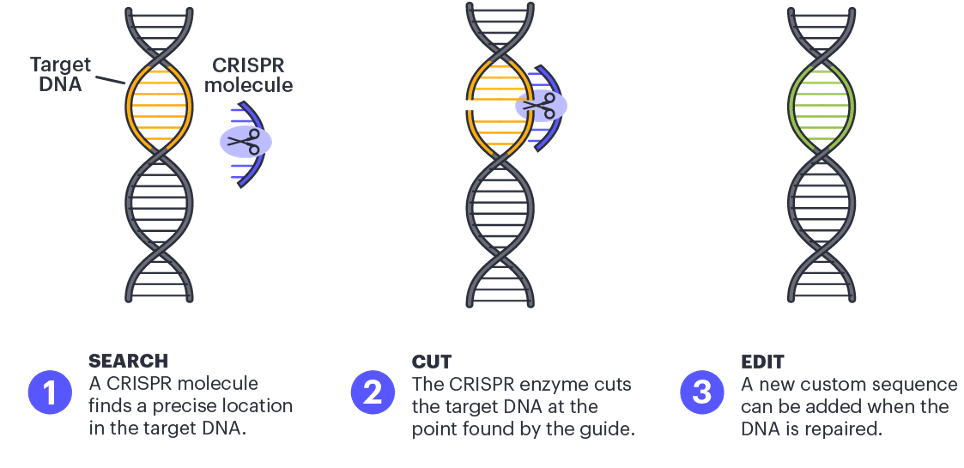
Scientists often use CRISPR to “knock out” a gene, essentially breaking it and causing a cell to stop making the protein it codes for. Increasingly in recent years, it is being used to edit DNA sequences in the genomes of living organisms by adding new fragments of DNA for the cell to use as a repair template when it fixes the DNA cut.
In conclusion, CRISPR methods of genome editing give scientists powerful new tools to improve our lives and study fundamental questions of biology by having the ability to edit the DNA of almost any organism.